

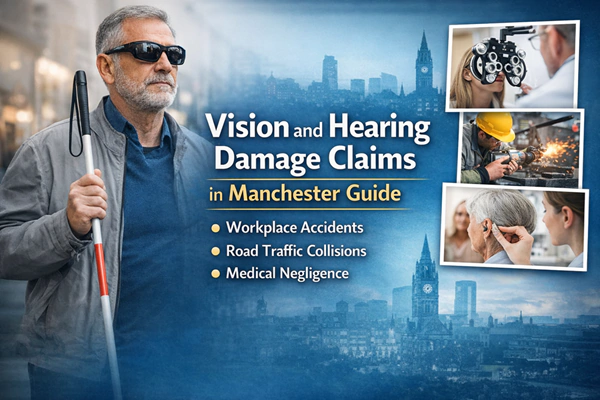
Loss of sight or hearing changes how a person connects with the world. Communication becomes more challenging, everyday tasks require more effort, and the impact on independence may not always be immediately apparent to others. Serious accidents or avoidable medical errors in Manchester most often cause vision and hearing damage, which can have a permanent impact.
Unlike many physical injuries, sensory damage does not always limit movement. Instead, it affects awareness, interactions, and the ability to work and socialise. For many people, the consequences unfold gradually, as communication barriers begin to interfere with daily life.
How vision and hearing damage occur in Manchester
Vision and hearing damage can occur across a wide range of environments in Greater Manchester. Workplace accidents remain a common cause, particularly in industrial, construction, and manufacturing settings where eye protection or hearing protection is required but not properly enforced.
Exposure to loud machinery, repeated noise without adequate safeguards, or sudden acoustic trauma can lead to permanent hearing loss. In the same way, eye injuries from chemicals, debris, or broken equipment can cause partial or complete loss of vision.
Road traffic accidents are another frequent source of sensory damage. Head trauma, impact injuries, and airbag deployment can all affect sight or hearing, sometimes without obvious external injury at the time. In busy urban areas, collisions involving cyclists, pedestrians, or motorcyclists can be particularly severe.
Clinical failings also play a significant role. Delayed diagnosis, surgical errors, untreated infections, or incorrect treatment can result in avoidable sensory loss. In some cases, damage develops over time, making it harder to identify the original cause without specialist evidence.
The impact on communication and daily interaction
The defining feature of vision and hearing damage is its effect on communication. Conversations may become exhausting or confusing, particularly in noisy environments or group settings. People with hearing loss often struggle to follow speech, while those with vision loss may miss non-verbal cues, written information, or changes in their surroundings.
These challenges can lead to withdrawal from social situations, reduced confidence, and frustration. Everyday interactions that once felt automatic may now require planning, adaptation, or assistance.
In professional settings, communication difficulties can directly affect performance and progression. Meetings, phone calls, written instructions, and safety briefings may all become harder to manage, particularly where adjustments are not made.
Employment challenges and long-term work impact
Vision and hearing damage often have a disproportionate effect on employment. Even where individuals remain physically capable of working, communication barriers can limit the roles they are able to perform.
Some people find they can no longer work in noisy environments, operate machinery safely, or carry out roles that rely heavily on verbal communication or visual accuracy. Others may struggle with screen-based work, driving, or customer-facing positions.
In many cases, adjustments can make continued employment possible. However, these adjustments are not always offered promptly or effectively. Where sensory damage prevents a return to previous work, retraining or a career change may be necessary, bringing financial and emotional strain.
Assistive technology and workplace adjustments
Assistive technology plays a crucial role in supporting independence after sensory loss. Hearing aids, cochlear implants, visual aids, screen readers, and specialist software can significantly improve quality of life, but they often require ongoing maintenance, assessment, and replacement.
Workplace adjustments may include modified communication methods, adapted equipment, flexible working arrangements, or changes to the physical environment. These measures can be essential in allowing individuals to remain employed and independent.
The need for assistive support is not a one-time issue, further adjustments may be required over time as technology evolves and conditions change.
Quality of life and long-term adjustment
Beyond work and communication, vision and hearing damage can affect many aspects of daily living. Navigating public spaces, using public transport, managing finances, and accessing services may all become more difficult.
Loss of independence can also affect mental wellbeing; feelings of isolation, anxiety, and loss of confidence are common, particularly where sensory damage is permanent. These effects may not be immediately visible but can have a lasting impact.
Adjustment is often an ongoing process rather than a fixed outcome; support needs can change over time, particularly as individuals age or as technology and circumstances evolve.
When vision or hearing damage becomes legally actionable
Not all cases of sensory damage result in a valid compensation claim. To be legally actionable, it must usually be shown that the injury was caused by a failure to take reasonable care.
In workplace cases, the responsibility often turns on failures to provide adequate protective equipment, enforce safety procedures, or assess risks appropriately. Employers are expected to anticipate hazards that could affect sight or hearing, particularly in high-risk environments.
In road traffic cases, liability may arise where another party failed to drive safely or observe traffic laws. In clinical cases, the question is whether the sensory damage was avoidable through timely diagnosis or appropriate treatment.
These claims typically rely on detailed medical evidence and expert opinion to establish causation and long-term impact.
Getting advice on vision and hearing damage claims in Manchester
Vision and hearing damage can permanently change how a person lives and communicates. Legal advice cannot restore lost senses, but it can help secure the support needed to adapt and maintain independence.
Speaking to a solicitor experienced in serious injury and medical negligence claims can help clarify whether sensory damage may be legally actionable and what support may be available. For those affected in Manchester, local understanding of workplaces, healthcare systems, and accident environments can be particularly valuable.