

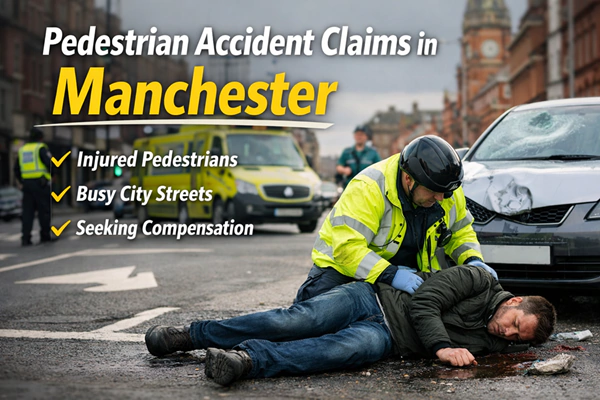
Pedestrians rely on the road environment to work properly. Crossings, pavements, traffic flow, and driver attention all have to align for streets to be safe on foot. When they fail to align, pedestrians are left exposed with no physical protection and very little ability to avoid impact.
In Manchester, pedestrian accident claims often arise in busy urban areas where foot traffic, vehicles, and infrastructure intersect. The issue is rarely speed alone. It is visibility, expectation, and whether drivers and authorities fulfilled their duty of care.
Why pedestrians are uniquely vulnerable
Pedestrians move slowly relative to traffic and have limited ability to react when something goes wrong. Unlike drivers or riders, they cannot accelerate away or alter course quickly.
Urban environments increase this vulnerability. Complex junctions, parked vehicles and street furniture disrupt sightlines, and pedestrians frequently need to judge traffic gaps under pressure.
Children, older people, and those with mobility issues are particularly at risk, but even able-bodied adults can be caught out when crossings are unclear or driver behaviour is unpredictable.
Common causes of pedestrian accidents
Many pedestrian accidents involve driver inattention rather than deliberate risk-taking.
Vehicles may fail to stop at crossings, turn into pedestrians at junctions, or pull out without checking pavements properly. Distraction, impatience, and misjudgement all play a role.
Parked vehicles can also obstruct views, making it harder for drivers to see pedestrians stepping into the road and harder for people walking to judge approaching traffic. In these situations, responsibility often lies with the driver to proceed cautiously.
In some cases, road layout or signage contributes to confusion, increasing the likelihood of collision even where pedestrians are following expected routes.
Crossings, pavements, and expectation of safety
Pedestrians are entitled to assume a basic level of safety when using crossings and pavements.
Marked crossings, traffic lights, and pedestrian priority zones exist to manage risk. Neglecting or poorly maintaining these features unfairly shifts the risk onto pedestrians.
When crossings fade, signals malfunction, or traffic flow encourages drivers to prioritise movement over observation, accidents frequently occur. In these cases, the question is not just what happened, but whether the environment was set up safely.
Injuries commonly suffered by pedestrians
Pedestrian injuries are often severe because impact is direct and unprotected.
Fractures, head injuries, spinal injuries, and internal trauma are common, even at relatively low vehicle speeds. Secondary impact with the road surface can significantly worsen injury severity.
Recovery can be lengthy and unpredictable. Some pedestrians face lasting mobility issues, chronic pain, or psychological effects that affect independence and confidence outdoors.
Psychological effects and loss of confidence
People often underestimate the psychological impact of a pedestrian accident.
People may become anxious about crossing roads, avoid busy areas, or change routines entirely. This loss of confidence can affect work, social life, and independence, particularly for those who relied on walking as their primary mode of transport.
For some, the fear persists long after physical injuries have healed, especially where the accident felt sudden or unavoidable.
Determining who is responsible in pedestrian accident claims
Liability in pedestrian accident claims depends on a careful assessment of the driver’s behaviour and road conditions.
Drivers are expected to anticipate pedestrians, particularly in urban areas, near crossings, schools, and shopping areas. Failure to observe properly, excessive speeds for conditions, or unsafe turning manoeuvres are common bases for claims.
In some cases, liability may also involve local authorities where unsafe road layouts, poor maintenance, or inadequate signage contributed to the accident. Evidence of prior complaints or known hazards can be relevant.
Evidence that supports pedestrian claims
Evidence is critical in pedestrian accident cases, especially where drivers dispute fault.
CCTV footage, dashcams, and witness statements often play a key role. The position of crossings, traffic signals, and road markings can also be important.
Medical records documenting injury severity and recovery are central to assessing impact. Early reporting and documentation strengthen the overall claim.
Contributory negligence and pedestrians
Pedestrians are sometimes accused of contributory negligence, for example, by crossing away from designated points or stepping into the road unexpectedly.
Each allegation must be assessed in context. The presence or absence of a crossing, visibility, traffic speed, and driver reaction all matter. Even where a pedestrian made a minor error, drivers still have a duty to take reasonable care.
Contributory negligence does not automatically prevent a claim, but it can affect compensation. Understanding how and why it is raised is important.
When a pedestrian accident becomes legally actionable
A claim may arise where a pedestrian is injured due to another party’s failure to take reasonable care.
This includes situations where:
- A driver failed to observe or stop in time
- A vehicle turned across a pedestrian’s path
- Crossings or signals were ignored
- Unsafe road conditions contributed to risk
The focus is on whether the pedestrian was placed in danger that could reasonably have been avoided.
Longer-term impact on daily life
Pedestrian accidents can alter daily routines significantly.
Walking could become painful or difficult, affecting public transport access and increasing reliance on others. Where walking was essential for commuting or independence, these changes are particularly disruptive.
Physical injury is not the only long-term impact. Confidence, mobility, and quality of life are all relevant considerations in pedestrian accident claims.
Why early advice matters
Pedestrian accident claims benefit from early legal advice. Evidence can be lost, road layouts may change, and memories fade.
Early guidance can help secure footage, clarify liability, and ensure injuries are properly assessed. It also helps manage contributory negligence arguments before positions harden.
Seeking advice early is often about protecting clarity and options.
Getting advice on pedestrian accident claims in Manchester
Pedestrians have little protection when accidents occur. Understanding whether that risk arose from another party’s failure is essential.
Speaking to a solicitor experienced in pedestrian accident claims can help assess liability, injury impact, and available options. Local knowledge of Manchester’s streets, crossings, and traffic patterns can be an important part of that assessment.