
Industrial machinery is designed to perform tasks with force, speed, and precision. When it is used correctly, within a controlled environment, risk should be minimised. When safeguards fail, the consequences are often severe.
In Manchester, industrial machinery accident claims commonly arise in factories, warehouses, and production environments where equipment is powerful, repetitive, and unforgiving. The issue is rarely bad luck; it is usually about control, training, and whether safety systems were allowed to break down.
Why machinery accidents are different from other workplace injuries
Machinery-related injuries tend to happen suddenly and with little opportunity to avoid harm. Unlike slips, trips, or manual handling injuries, there is often no warning and no chance to step away once something goes wrong.
Machines do not adapt. They continue operating at the same speed and force unless stopped, which means even brief failures can result in serious injury.
This is why the law places heightened responsibility on employers where machinery is involved.
Common types of industrial machinery involved in accidents
A wide range of machinery is linked to serious workplace injuries.
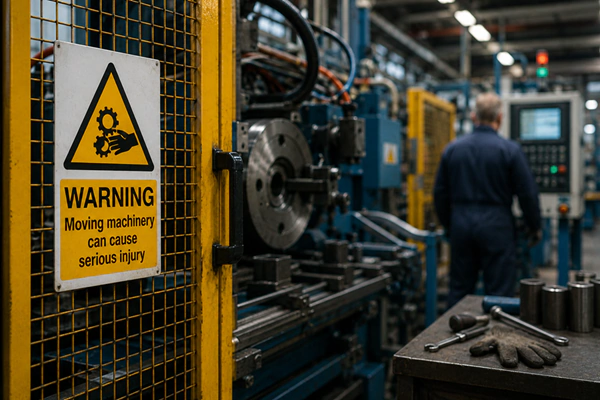
Conveyor systems, cutting equipment, presses, automated production lines, and fixed plant machinery all carry inherent risk. Guarding failures, exposed moving parts, and emergency stop issues are frequently identified after accidents occur.
In some cases, older machinery lacks modern safety features. In others, safeguards exist but are bypassed to maintain output or speed.
How machinery accidents typically occur
Machinery accidents rarely result from a single isolated error. More often, they follow a predictable pattern.
Risk assessments may be out-dated or generic, training may be rushed or incomplete, and supervision may be limited. Temporary staff or agency workers are particularly vulnerable where they are unfamiliar with equipment.
Maintenance is another key factor. Worn parts, faulty sensors, or disabled safety interlocks can turn routine tasks into dangerous ones.
When production pressure overrides safety controls, the margin for error disappears.
In many workplaces, risk does not increase suddenly; it builds quietly. Guards are loosened to speed up tasks, alarms are silenced because they interrupt workflow, and unsafe shortcuts become routine. Nothing happens at first, which reinforces the behaviour.
This normalisation of risk is a common feature in machinery accident claims. What eventually causes injury is not an unexpected malfunction, but the predictable result of safety systems being treated as optional rather than essential.
By the time an accident occurs, the danger has often been present for some time.
The role of training and supervision
Proper training is essential in machinery environments. Workers need to understand not only how to operate equipment, but when not to.
Accidents often occur where training focuses on productivity rather than hazard recognition. Workers may not be taught how to shut down machinery safely, respond to malfunctions, or identify warning signs.
Supervision matters as well. Where unsafe practices become normalised, risk increases over time until an accident occurs.
Production pressure and unsafe practices
Production targets can place subtle pressure on safety standards. Where output is prioritised over process, workers may feel discouraged from stopping machinery or reporting faults.
Accidents frequently occur where staff are expected to keep equipment running despite known issues. Temporary fixes are applied, maintenance is delayed, and responsibility is passed between shifts.
These pressures are relevant when assessing liability. A system that encourages unsafe continuation is not a safe system, even if no incident has occurred previously.
Injuries commonly caused by machinery accidents
Machinery accidents often result in serious physical injury.
Crush injuries, fractures, amputations, severe lacerations, and nerve damage are all common. Injuries may involve multiple body parts and require extensive treatment.
Recovery is often prolonged and uncertain. Some injuries result in permanent limitation or loss of function, affecting both work and daily life.
The severity of these injuries is a key reason machinery accidents are treated differently from lower-risk workplace incidents.
Employer responsibility and legal duties
Employers have a duty to ensure that machinery is safe, properly maintained, and suitable for the task being performed.
This includes providing adequate guarding, effective emergency stops, appropriate training, and regular inspection. Employers are also expected to review risk assessments and update them when processes or equipment change.
Employer duties extend beyond written policies. Safety systems must work in practice, not just on paper.
Risk assessments must reflect how machinery is actually used, including foreseeable misuse or shortcuts. Training must be refreshed, not treated as a one-off requirement, particularly where equipment or processes change.
Where employers rely on out-dated assessments or assume that experience alone will prevent accidents, risk increases over time.
Investigating machinery accidents
Machinery accident claims are evidence-heavy.
Investigations often examine maintenance records, risk assessments, training logs, and accident reports. The condition of the machinery itself is frequently central, particularly where guarding or safety systems failed.
Witness accounts and expert engineering opinion may be required to understand how and why safeguards failed.
Early investigation is important, as equipment may be repaired, altered, or removed after an accident.
Warning signs before machinery accidents
Many machinery accidents are preceded by warning signs.
Near misses, minor injuries, unusual noises, vibration, or repeated stoppages are often recorded before a serious incident occurs. These signals indicate that controls are failing or being bypassed.
Failure to respond to these warning signs is often central to liability. An accident that could have been prevented with earlier intervention is rarely treated as unavoidable.
When an industrial machinery accident becomes legally actionable
A claim may arise where an accident was caused by a failure to manage machinery safely.
This includes situations where guarding was missing or defective, training was inadequate, maintenance was neglected, safety systems were bypassed, or risk assessments were insufficient.
The question is whether reasonable steps were taken to prevent foreseeable harm.
Long-term impact on employment and earning capacity
Machinery injuries often affect a person’s ability to return to the same role.
Physical limitations, reduced strength, or loss of function can make industrial work impossible. Even where alternative duties are offered, career prospects may be reduced.
In some cases, returning to any industrial environment is no longer realistic. Physical limitation, reduced dexterity, or loss of confidence around machinery can make similar work unsafe.
Retraining, redeployment, or permanent career change may be required. These consequences are particularly significant where industrial work formed the core of a person’s employment history.
Long-term earning capacity, not just immediate income loss, is therefore a central issue in machinery accident claims.
Why early legal advice matters
Machinery accidents are often investigated internally by employers soon after they occur. How an incident is recorded can influence later outcomes.
Early legal advice can help ensure that the accident is assessed independently and that evidence is preserved. It can also help injured workers understand their rights before positions become fixed.
Seeking advice early is often about balance and clarity, not confrontation.
Getting advice on industrial machinery accident claims in Manchester
Industrial machinery injuries can change a person’s working life in an instant. Understanding whether that injury was preventable is critical.
Speaking to a solicitor experienced in industrial machinery accident claims can help assess liability, long-term impact, and future options. For workers in Manchester, local knowledge of industrial environments and employer practices can be an important part of that assessment.